Thursday, December 21, 2006
Monday, December 18, 2006
Monday, December 11, 2006
Monday, November 20, 2006
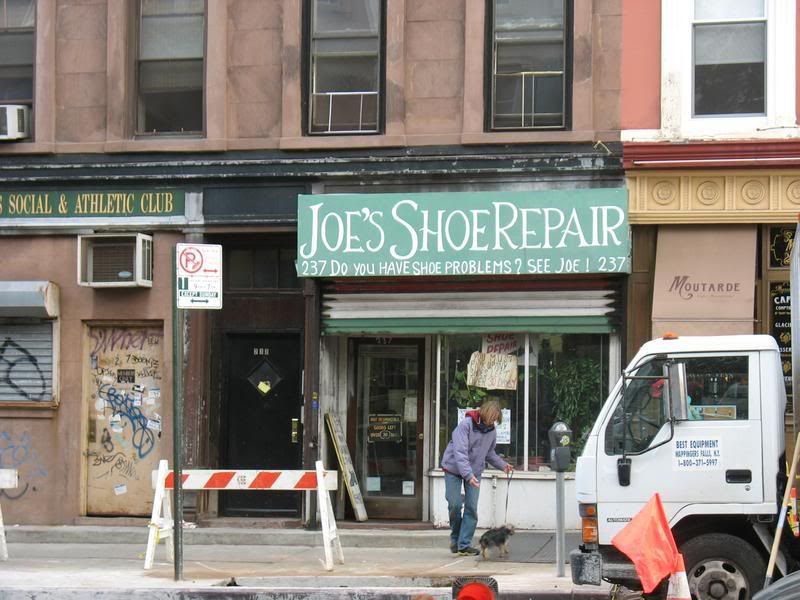
You may just pass by it and never notice that it’s there, unless the “Joes Shoe Repair from Union St/7th Ave” sing is placed on the sidewalk. But the wooden sign, black and red letters on a white board, is so old and weathered that you might easily miss it.
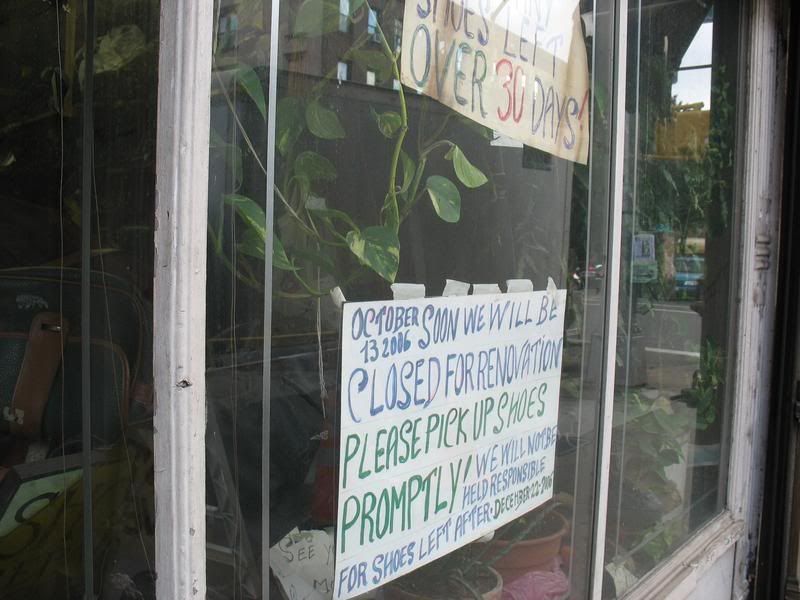
Next to an upscale French restaurant, across the street from a Natural Market on the busily gentrifying 5th Avenue in Park Slope, Joe’s store is like something somebody forgot here from the olden days. The store window’s glass is dirty. The window itself is full of randomly tossed shoes and leather coats. Two signs made on a white paper with three different color crayons are glued on glass: “October 13 2006, Soon we will be closed for renovation. Please pick up shoes promptly.” And: “We will not be held responsible for shoes left after December 22 2006. You must pick up any shoes left over 30 days!” Two plants are hanging from the ceiling, taking over the upper part of the window.
“I like to take it easy. It’s too busy here,” Joe said inside the miniscule store, where, if he wanted to spread his arms, he would almost reach wall-to-wall. But the walls are not visible, because they are covered with shelves and the shelves have mountains of shoes, sneakers, boots and sandals on them. Old sanding machines remind the guest that there is actually work taking place here. Dust covers everything. Its height determines how long nobody touched an object. A narrow path is kept free on the floor for Joe to walk around. The distinctive smell is of old leather.
The L-shaped counter right behind the door holds an ancient metal cash machine, the kind where a $ sign and a number jump up when a key is stricken. It does not give a receipt. Next is a small space on which customers can put the shoes-to-be-repaired. Around the corner is an area blocked by a white plaster panel behind which Joe works.
Across from the counter, a radiator heats up the room quickly, and above it, the wall is covered with souvenirs: A big, framed picture of Jesus Christ. In the corners of the frame is a picture of Joe’s two grandchildren, a girl and a boy; a picture of St. Giovanni; and a picture of Joe on his son’s motorbike. Next is a big wooden frame with a picture of a town in Sicily. Below is a picture of Joe with a group of kids in front of his store.
“It was about eight or ten years ago,” Joe said with a wide gesture of his left hand, while his right was holding a black leather boot. “They wanted to see what I am doing,” Joe said, obviously unimpressed.
Joe is one of the last of his kind. The cobblers, the picture framers, small appliance repair places, barbers, print shops and other one person neighborhood business are leaving the area and are being replaced by restaurants, French pastry shops, fancy coffee shops and upscale clothing stores. In the Park Slope area, Joe and another shoe repair store run by an Asian couple are the last two left.
A man in his 60s, Joe is short, with all white hair and a flirtatious smile. He moved to New York as a young man from Italy and never learned English well.
“I came and did this and that and then someone called me to help with shoe repairs. I did a little bit at the beginning. Then more. And then I took over the store. This was on 7th Avenue. Later, one guy bought half the block and started renovating. When my lease was up, he wanted $1,200 a month and offered me a 3 year lease. This was 18 years ago. I paid $500 before. So I moved here. This was cheap” Joe said while nailing a new heel on a black boot.
A store front rental on 7th Avenue nowadays goes for around $3000. No small business can survive with a rent this high.
5th Avenue started changing about 5 years ago, when many new restaurants opened and received good reviews in local and city papers. The avenue got a new asphalt coat. Dozens of luxury coop and condo houses were built during the recent real estate boom and new, wealthier occupants moved in. They too needed someone to fix their shoes. Joe had no complaints about not having enough costumers.
When he was done with a repair, Joe put the shoe somewhere on a shelf. Some of the shoes had little pink slips attached to them, but he did not put the shoes in any particular order.
A woman in her 40s came in. She had a pink slip. “This is my third time here,” she whispered to me while Joe was looking for her shoes. “He can’t remember anything. I left three pairs here and he couldn’t find them.”
Together, Joe and the woman finally located all three pairs and Joe added up on the old cash machine that she owed him $30. “You are lucky I don’t charge you for the times I came here in vain,” she said to him. “$30 even,” he replied and did not seem to notice that the woman was annoyed.
“They will now renovate this building,” Joe said after the woman left. “If they want a lot more money for rent, I will not take it.”
“I don’t know what I will do. I will retire,” he added. His sons don’t want to take over the business. One of them is a police officer and the other has a college degree. Once his nephew wanted to learn the trade and maybe take over the business, but Joe was the one discouraging him.
“I said, ‘Go do something better. There is no big money in this business. It’s lots of work. Many hours,” Joe explained. “If I have to close, I close. I don’t care. But I can’t stay home. What will I do?” he asked with a mischievous smile.
Wednesday, November 15, 2006
Saturday, November 11, 2006
Thursday, November 09, 2006
Monday, November 06, 2006
Marcia Bodenstein, a 56 year-old entrepreneur from
Bodenstein, who grew up in an orthodox Jewish household, in which on Saturdays lights were not switched on and the kitchen was kosher, was used to synagogues where women and men were separated, and people were obliged to buy tickets for High Holy Days, feared God and were isolated. She was 15 when she discovered ham sandwiches and pizza. As an adult, she never went to her old synagogue, except with her widowed father, but kept searching for a more progressive congregation. After finding one that she liked in
At this Kol Nidre service, Bodenstein was surprised to see a woman standing on the podium as a rabbi. Moreover, the cantor was a woman too and the rabbi spoke English. The church was filled with people of all colors and socio-economic backgrounds. There were families with children, singles, straight and gay couples, lesbians, gay men, young and old. As a widow, Bodenstein felt at ease.
About 700 people came for the service that day with Bodenstein, organized by the progressive Jewish congregation in the upscale Park Slope neighborhood in
Lippmann, who was then the East Coast director of the organization MAZON – A Jewish Response to Hunger, invited ten friends for dinner to talk about a possible congregation in early 1993. The discussion continued over the following weeks and by the summer months, a once a month Sabbath dinner and a Saturday morning Torah study group were established. The congregation hired a teacher for the children the same year and for High Holy Days, Kolot welcomed 75 people.
The group started out on folding chairs in Kensington,
“I don’t believe in tickets for High Holy Days,” Rabbi Lippmann said. “When the issue comes up, and it does come up regularly as a way to raise money, I always say, ‘You can have tickets, but then you have to look for another rabbi.’ We do ask for contributions, though,” she added.
The other principle on which Kolot Chayeinu was built, is that the group eats first, and then prays. Rabbi Lippmann came up with this idea when she was, as a MAZON director, traveling and giving speeches in synagogues around the
“I joined with four other gay men and lesbians who’d been active in AIDS organizing in
For Wolfe, it was more important to be in a synagogue which welcomes all people than to be in a gay synagogue. “As a Jew, it was great to see a 70 year old woman from
Wolfe’s bar mitzvah ceremony was the first occasion when his parents met the parents of his lover of nine years, and his grandmother came to visit the home he shares with his lover.
Lisa Zbar, the 51 year old former Kolot Chayeinu President, a documentary film maker and a mother of two, grew up going to a reform synagogue, still felt left out of Judaism. She knew that she wanted a place where her husband, who is from the
When in 1995 a friend suggested Kolot, Zbar went to talk to the rabbi and immediately liked what she stood for. “I liked the idea that my children would know all kinds of adults – from single straight people to lesbian couples” she said. Even though Judaism had always spoken to her, Zbar never imagined that going to shul would mean so much to her. She wanted to be on the inside of “this Jewish thing,” she said, and wanted her children to be part of it too. Now she attends Shabbat services with her family. As the media is projecting fear and the country leans towards separatism, Zbar feels that Kolot and her home in which religious practices become cultural ones, are the right antidotes.
Kolot Chayeinu, which now has 230 due-paying members, is a progressive congregation not only because it welcomes all kinds of people, doesn’t charge for High Holy Day tickets and eats before prayer, but also because of what is stated in the group’s mission statement: doubt can be an act of faith.
“Kolot’s members have a wide range of opinions about
“A congregation like this lets people live their social agenda through their religion,” Professor Ari Goldman of Columbia School of Journalism and a former New York Times reporter covering religion, said. “It has been a Jewish tradition ever since the Enlightment to reject the constraints of the old and reinterpret them – being Jewish on ones own terms,” he added. This is especially true for those who came from a family where they were exposed to an orthodox variation of Judaism, Goldman said.
It is indeed true for Marcia Bodenstein, who, after the initial first service came back the next day to a service honoring the dead. “We all stood up and said the names of our dead. I said the name of my husband,” Bodenstein said. “Later, a man read the names of all countries that were at war. I felt that my heart was there too, not just my body. I did not look at my watch once. I felt that this is where I belong,” she added.
Sunday, November 05, 2006
Thursday, November 02, 2006
Thursday, October 26, 2006
Friday, October 20, 2006
Wednesday, September 20, 2006
Sunday, September 03, 2006
Even if they lived outside of New York City at the time, passers by on Brooklyn streets felt their lives influenced by the terrorist attacks of 9/11. The six people I interviewed on a rainy day in late August almost five years after the attacks said that the possibility of another terrorist attack was on their minds. But they still felt safe in Fort Greene, the multicultural neighborhood of charming brownstones and abundance of greenery.
“My sister picked up smoking,” said Jeremy Wooster, 19, of Canarsie, when asked about 9/11 and its influence on his life. “She was looking for my brother and me that day and couldn’t find us. She didn’t know what else to do.”
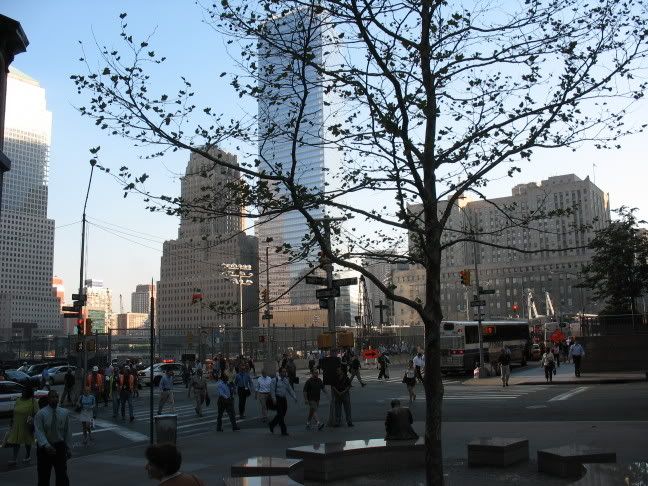
Wooster, now a Bard College student, was attending a high school at the time of the attacks just a few blocks from The World Trade Center. His school was evacuated and after four days off, he and his schoolmates were for a month sharing a high school in Brooklyn. “The Brooklyn kids hated having us there. It was a bad experience. They should have given us more time off,” Wooster said. Now working at the Jewish Heritage Museum, he still visits Ground Zero often and is not happy about what he sees. “The small businesses are all gone. The places we used to go for lunch, they are all gone.”
“Tourists coming to Ground Zero really bother me,” Wooster added.
“It’s a huge graveyard really. Thousands of people are buried there and [tourists] come to take a picture. It angers me. I think it’s creepy.”
Sunny Kim, 30, of the Lower East Side, lived and went to school near Ground Zero in 2001. After September 11, she quit her job and moved out of the city. “There were other reasons for me to leave as well,” she said, smoking a cigarette outside a Laundromat. “I have never been to the site,” Now working as a teacher, Kim said. “I have people who come visit me and they say, ‘Hey, let’s go!’ and I just say, ‘Here is a map, you go.’ I can’t. I just can’t. And I am not a very emotional person.”
Meg Forbes, a retiree of Fort Greene heard about the first plane crash on the radio and thought that it was a “bad joke”. Later, when her sister called, she looked out the window and saw the smoke coming out of the tower. “I sat in my chair and I stayed in that chair until about 6 in the evening. I called everybody I knew,” she said.
Forbes attended a jazz concert at the World Trade Center the Friday before the attacks. “I was looking at all those pretty young girls and I thought to myself, wouldn’t it be nice to be this young, work in this beautiful building and make all this money. And look at it now, it’s all gone,” she said. When asked how 9/11 influenced her life, Forbes said, “Not a day goes by that I don’t think about it. I look out the window and see the empty space where the towers used to be. You wanna know how it influenced my life? I tell you. It made me miserable!”
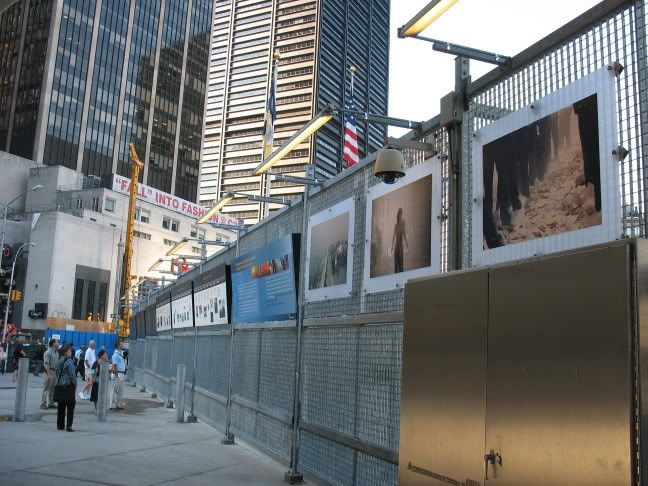
Despite her strong emotions, Forbes is now able to travel around Downtown Manhattan. “I take the bus and look at the construction from the window. I hear there is an exhibit there now. I decided to go see it,” she said.
The majority of people interviewed expressed that they don’t feel safer seeing police with machine guns around the city and in subway stations. “I think the money spent on manhours of all those cops standing around chatting, could be better used,” Wooster said, adding that another attack on New York City would not surprise him.